Ask a player what changes their tone and you'll hear the same short list: pickups, wood, strings, amp. The bridge almost never comes up. It gets filed under hardware, the same category as strap buttons and tuner bushings, something that holds a part in place while the interesting components do the work.
But the bridge is one of the two points where the vibrating string physically ends. Every note you play has to pass through it. If you want to understand why one guitar blooms and another dies somewhere around the twelfth fret, that's where to start looking.
What a Bridge Actually Does
A string is fixed at two ends. At one end it's the nut or whatever fret you're holding down. At the other it's the saddle. Those two terminations define the vibrating length, which is the part everybody knows, and they determine how much of the string's energy stays in the string, which is the part that matters more.
A termination that moves absorbs energy. Every time the string pulls against a saddle that can flex, rock in its slot, or shift under tension, some of that motion becomes movement in the hardware instead of vibration in the string. It doesn't come back. You hear the absence of it as a note that arrives smaller than you expected and leaves sooner.
The technical framing is mechanical impedance. The bridge needs to present a high-impedance boundary at the point of contact, meaning it resists being moved by the string. Mass is the most direct way to get there. A heavier, more rigid termination holds its ground, so more energy stays in the string, and the energy that does transfer moves into the body along a controlled path instead of being dissipated in loose parts.
How We Got Here
The bridges most players consider canonical were manufacturing decisions before they were tonal ones.
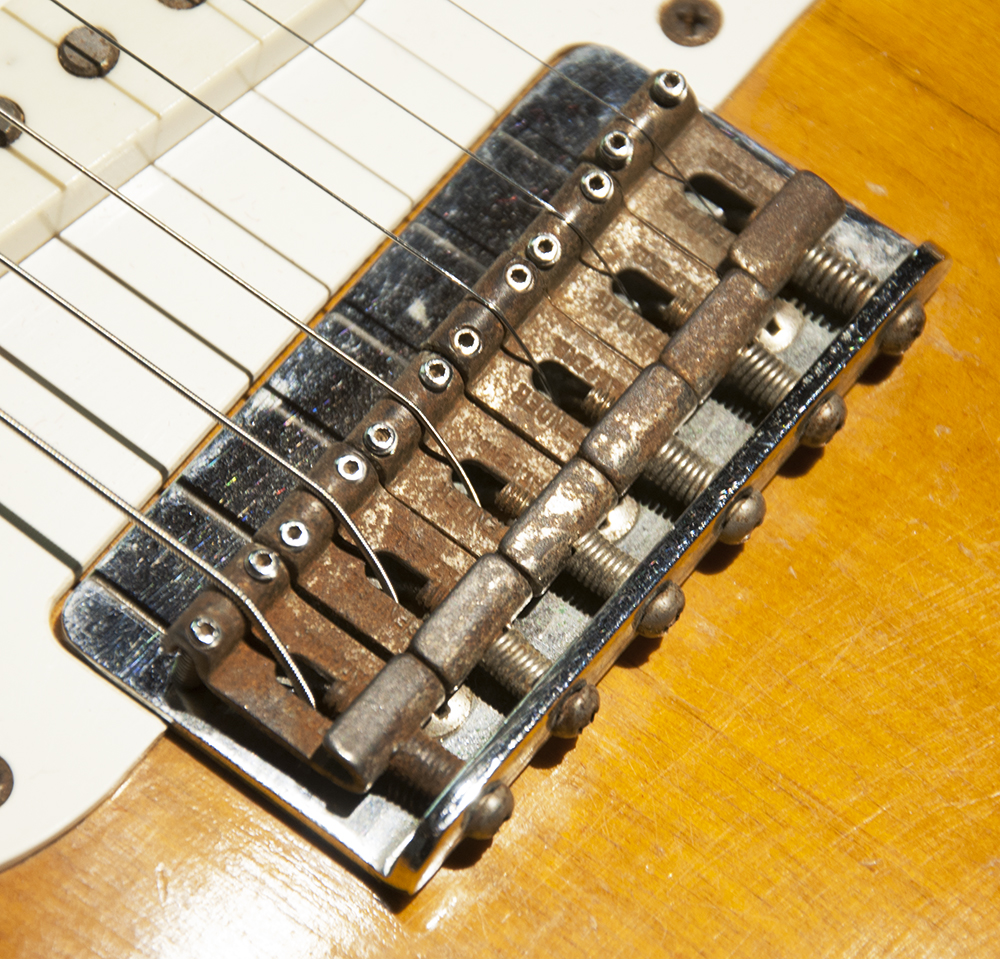
Fender's 1950 design put three brass barrel saddles on a folded steel plate. It was cheap, fast, and easy to assemble, and it forced two strings to share every saddle, which is exactly why vintage Telecasters have intonation compromises built into them from the factory. The Stratocaster went to six bent-steel saddles on a stamped plate, sitting over an inertia block. That block tells you Leo understood the mass argument perfectly well. He just applied it underneath the plate rather than at the saddles, where the string actually makes contact.
Gibson took a different route with the tune-o-matic and stopbar, which puts considerably more metal in the path and terminates the string more solidly. It also suspends a thin bridge across two posts, and thin bridges under sustained tension do what thin things under tension do.
None of this was wrong for the moment it was made in. These were sound engineering answers to the question of how to build a good guitar quickly and affordably in the middle of the last century. What happened afterward is that the compromise hardened into orthodoxy. Seventy years on, we call it vintage-correct and copy it without asking what it was correct for.
What Mass Buys You
Four things change when the termination gets solid enough.
The fundamental gets stronger. With a compliant bridge, energy that should be in the fundamental bleeds into upper partials and mechanical noise. Tighten the termination and the note recenters. It sounds bigger without being louder, which is a distinction you feel more than measure.
Sustain lengthens, and more importantly it changes character. Less energy lost at the saddle means the note decays along a natural curve instead of falling off a cliff. The tail is as much a part of the note as the attack.
Notes separate. When six strings terminate on a shared platform that can flex, they modulate each other. Give each string a rigid termination of its own and a chord stops smearing. You hear voices instead of a block.
And response evens out across the neck. Dead spots, the notes that just refuse to sustain the way their neighbors do, are almost always a coupling failure somewhere in the chain. The bridge is one of the two most common places to find one.
Where the Argument Stops
Mass is not a free variable, and anyone selling it as one is overselling.
Past a certain point, additional weight stops improving the termination and starts changing other things: how the instrument balances on a strap, how the body responds, how the guitar feels across a three-hour set. There's a working range, and beyond it you're just carrying metal.
The more useful correction is that the number on the scale was never the point. What matters is the rigidity of the entire contact path, from the string's contact with the saddle, through the saddle's seat, through the baseplate, into the body. A heavy bridge resting on two small posts hands back most of what the weight gave you. So does a heavy saddle that can rock in an oversized slot. Mass without contact is just weight. This is why the aftermarket solutions that genuinely work, the ones from builders like Mastery and Callaham, aren't only heavier than what they replace. They're better fitted.
The Artifact Bridge
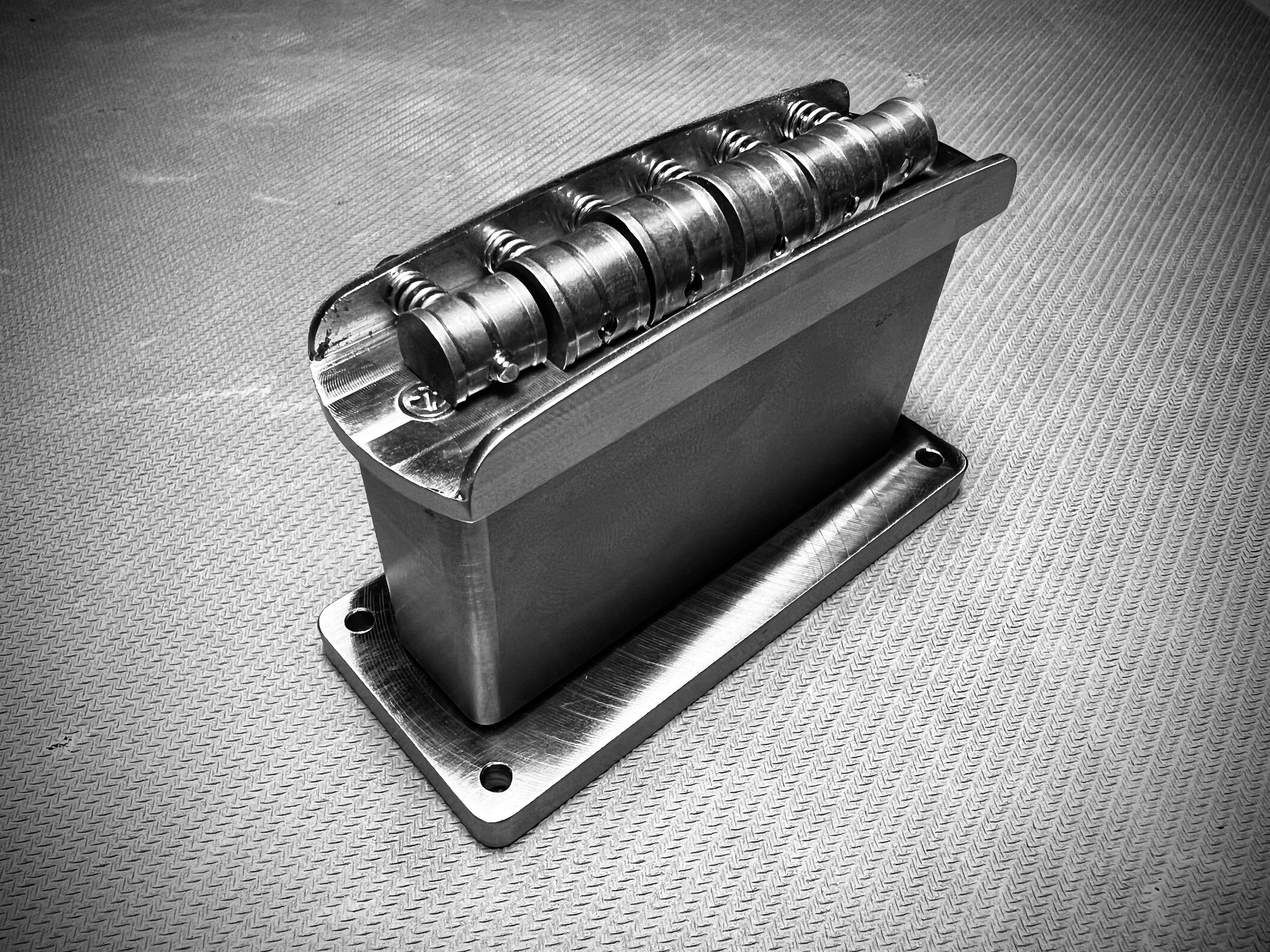
The Artifact bridge is three pieces: six individual fixed-radius saddles, an adjustable sustain block, and a rear baseplate secured with machine screws into threaded body inserts. Every one of those choices exists to serve the contact path.
Individual saddles mean every string gets its own termination and its own intonation, with none of the two-strings-one-saddle compromise. Cutting the radius into the saddles rather than approximating it by adjusting six heights means each string sits in a seat machined for it, with full contact, instead of balancing on whatever surface a height screw happened to leave available.
The adjustable sustain block lets action be set without altering the mass or disturbing the contact geometry. Action and coupling are usually traded against each other on a conventional bridge. Here they're separate adjustments.
Machine screws into threaded inserts, rather than wood screws into the body, matter more than they sound like they should. Metal threads engaging metal threads don't loosen, don't wallow out their holes over years of tension cycling, and keep the whole assembly clamped as a single rigid unit. A bridge that stays tight in year forty is a different instrument than one that doesn't.
The result is a level of coupling and resonance that surpasses vintage configurations, audibly and measurably. Not because more metal is inherently better, but because every gram of it is doing structural work in the path between the string and the body.
What to Listen For
Play unplugged first, the same way you would when evaluating a neck joint. Fret a note high on the neck and listen to how it decays. It should taper. If it stops abruptly, energy is going somewhere other than the string.
Then play the same pitch in two or three different positions and compare. Large differences in sustain between positions point to a coupling problem, and the bridge is the first place to check.
Palm mute across the bridge and pay attention to your hand. On a loose assembly you can feel the hardware move under the heel of your palm. You shouldn't be able to.
Then plug in. A well-terminated string reads as a stronger fundamental, a cleaner attack, and a note that ends rather than disappears. Chords stay legible under gain instead of collapsing into a single mass.
The string can only be as good as the two things holding it still.